 Raydium
 routes Solana swaps through quoted pool paths before on-chain balances confirm the result
Raydium routes Solana token swaps through one or more liquidity pools, then settles the selected path in an on-chain transaction. Before signing, review the quoted output, pool route, price impact, fees and minimum received amount. Afterward, the transaction status and token balance changes show whether the exchange completed as expected.
The same protocol also supports liquidity positions and token launches, while its perpetuals interface uses separate infrastructure. Keeping those functions apart matters because a spot quote, a pool position and a derivatives order produce different records and risks.
Exchange modes and the pools behind each quote
An exact-input swap fixes the amount spent and calculates the expected output. An exact-output swap fixes the desired receipt and calculates the required input when the available route supports that mode. In either case, the quote is calculated before the wallet authorizes a transaction. It can change as pool balances, active liquidity or fee settings change.
Raydium spot swaps execute through on-chain automated market maker pools on Solana. A constant product market maker, or CPMM, prices trades with a reserve curve and makes liquidity available across its full price range. A concentrated liquidity market maker, or CLMM, lets providers place liquidity inside selected ranges. That concentration can improve a quote when sufficient liquidity is active near the current pool price.
AMM v4 remains a legacy constant product pool type. Its former order-book integration is inactive, so present-day swaps through those pools use the automated market maker curve. A route may use one pool, pass the first output through another pool or split the input among multiple pools. Multi-hop and split paths are useful only when their combined fees and price impact still produce a better acceptable output.
From a live quote to a confirmed balance
A quote is a snapshot of a proposed exchange, not proof of execution. It should identify the input and output mints, the amount, the selected pool path and the limit that protects the trade. The wallet request then shows the transaction that will be signed. Signing authorizes submission, while confirmed execution creates the balance changes.
Use this decision checklist when predictable inputs and a verifiable output matter:
- Confirm the input and output mint addresses, available input balance and enough SOL for network costs.
- Choose exact-input or exact-output according to which side of the exchange must remain fixed, if both modes are available.
- Read the selected pools, expected output, price impact and every displayed pool or mint-level fee.
- Accept only a minimum output or maximum input that fits the intended exchange, then review the refreshed quote before signing.
- Keep the transaction signature and check its status, input decrease and output increase before treating the swap as complete.
A successful transaction can appear incomplete when a wallet display is stale or hides the output token account. Refreshing the balances may resolve the display, but the transaction record and its pre-transaction and post-transaction token balances provide the stronger reconciliation evidence.
For an exact-input swap, the pool output can fall below the earlier quote without crossing the selected minimum, so the difference remains within accepted slippage. For a Token-2022 asset with a transfer fee, the net amount reaching the account can also change because Raydium checks that minimum against the pool's gross output, not the amount left after the mint's transfer fee. If the transaction status shows an error, the quoted exchange didn't settle, even if the interface still displays the old route or estimated amount.
What changes a Raydium swap quote?
A quote changes when the relevant pool state or requested amount changes. A larger input consumes more of the available liquidity curve, which can move the execution price farther from the pool's starting price. In a CLMM route, only liquidity active across the crossed price ranges contributes to that trade. Two pools holding the same token pair can therefore return different outputs.
Price impact describes how the proposed trade moves through pool liquidity. Slippage tolerance serves a different purpose: it limits adverse movement between quoting and execution. For an exact-input swap, that protection becomes a minimum acceptable output. For an exact-output swap, it constrains how much input the transaction may spend. A route that crosses the relevant limit should fail instead of settling beyond it.
Pool trading fees reduce the amount that continues through each hop. Token-2022 assets may also carry a mint-level transfer fee, which is separate from the fee that the pool charges. A correct quote must account for the supported mint configuration and show the amount expected at the receiving account. Current fee settings belong in the live quote because pool and mint configurations can change.
A Solana priority fee affects transaction scheduling during congestion, not the quoted exchange rate. Paying more for priority may improve the chance of timely processing, yet it doesn't add liquidity or reduce price impact. If reserves change before execution, the router may produce a different path when the interface refreshes the quote.
Failed swaps and unchanged wallet balances
A slippage error means execution would have crossed the transaction's accepted limit. The swap instructions then fail rather than settling the proposed exchange. Insufficient input balance, inadequate SOL for transaction costs, stale pool data or changed route accounts can also prevent execution. Raising slippage doesn't repair an incorrect mint, missing balance or unavailable pool.
During congestion, a submitted transaction may remain unconfirmed, expire or fail. A higher priority fee can affect scheduling, but it can't repair invalid accounts or guarantee that a stale quote remains executable. Solana charges the transaction fee even when an executed transaction fails, while the failed swap's token state changes are rolled back.
If the transaction succeeded but the visible output appears unchanged, inspect the recorded token balance changes. The output token account may be hidden or the wallet may still show cached data. Wrapped SOL can also appear as a token balance rather than the wallet's main SOL balance until it is unwrapped. The transaction signature separates those display issues from an actual failed exchange.
Liquidity positions and token launches
Liquidity provision is a different action from swapping. A provider places assets into a pool and receives an LP claim or position record rather than an immediate exchange output. CPMM liquidity covers the pool's full curve. In a CLMM position, liquidity earns pool fees only while the current pool price is inside the provider's chosen range. Moving outside that range changes the position's asset mix and stops fee earning until price returns or the position is adjusted.
Pool fees may compensate providers, but they don't remove exposure to token prices or divergence from simply holding the assets. Configured farms can add token rewards, with eligibility and distribution depending on the particular pool and position type. Those rewards are separate from the swap output that a trader receives.
LaunchLab adds a token issuance path. Before graduation, buyers and sellers trade against a bonding curve. Reaching the configured graduation target closes that curve and migrates its liquidity into the configured post-graduation pool type, either AMM v4 or CPMM, where later trades use ordinary pool routing. Because token creation is permissionless, the mint address, curve progress and configured fees carry more identity and state information than a ticker or logo.
Do Raydium perpetuals use the same liquidity?
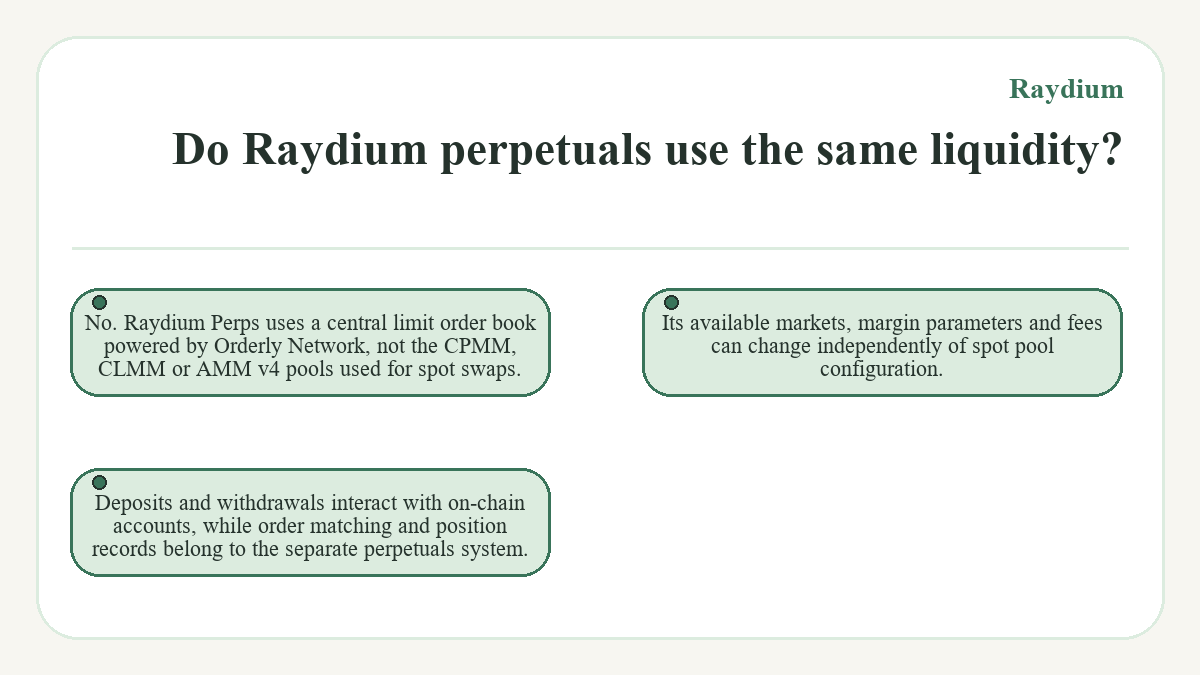
No. Raydium Perps uses a central limit order book powered by Orderly Network, not the CPMM, CLMM or AMM v4 pools used for spot swaps. Deposits and withdrawals interact with on-chain accounts, while order matching and position records belong to the separate perpetuals system. Its available markets, margin parameters and fees can change independently of spot pool configuration.
Spot and perpetual actions therefore end with different evidence. A successful spot swap has a Solana transaction signature and corresponding token balance changes. A perpetual trade instead produces an order or fill record and an updated position within the derivatives account.
Practical questions about Raydium
Do I need RAY to make a spot swap?
You don't need RAY to execute a Raydium spot swap. The wallet needs the chosen input token and enough SOL for the Solana transaction fee. Extra SOL may also fund a new associated token account for an output mint that the wallet hasn't held before. Before approval, review the quote and the transaction details that your wallet exposes.
Can Raydium route a Token-2022 asset?
Raydium can route supported Token-2022 assets through compatible pool programs. CPMM supports that token program, while CLMM uses Token-2022-aware swap instructions; AMM v4 doesn't support it. Mint extensions still matter. A transfer-fee extension can reduce the amount that reaches an account, and unsupported extensions can make a pool or route unavailable.
Is a confirmed Raydium swap reversible?
Raydium can't reverse an executed spot swap, but Solana distinguishes confirmed status from finalized status. Check for finalized status before treating the settlement as irreversible. Correcting an unwanted finalized exchange requires a new transaction, which receives a new quote and may incur fresh fees, price impact and slippage. Review the mint addresses and transaction details before signing.
Does Raydium add a separate fee for routing?
The Raydium router doesn't add its own fee to a spot route. Each pool applies its configured trading fee, and a multi-hop route can incur a fee at each hop. The transaction also has a Solana network fee. A Token-2022 mint may impose a transfer fee separately, so the route detail and final receive amount matter.
Does a split route settle one pool at a time?
A split route inside one Solana transaction settles atomically, not as independently final pieces. If a required Raydium instruction fails, the transaction's token balance changes are rolled back, although the network fee remains charged. An interface that constructs multiple transactions creates separate settlement boundaries, so each transaction signature needs its own status check.
How does custody work during a Raydium spot swap?
Raydium's spot programs don't take custody through a deposit account before the swap. Your wallet signs a transaction authorizing movement from your token account through the selected pool path, and the output reaches your token account if execution succeeds. Pool vaults hold shared liquidity, while the transaction signature and balance changes record the specific exchange.
Last updated ·