 Raydium
 liquidity pools across curves, fee tiers and price ranges
Raydium liquidity pools split the core choice between full-range CPMM liquidity and range-bound CLMM positions. CPMM keeps capital active across the entire constant-product curve, so it doesn't need range resets and its provider fees remain embedded in pool reserves. CLMM concentrates capital between selected price boundaries. While the position is active, that concentration can earn a larger share of fees per unit of capital, but it stops earning swap fees outside the range. Pool configuration, pair behavior, available liquidity and expected management effort belong in the same decision. A higher fee tier doesn't ensure higher income, and accrued fees don't erase losses relative to holding when token prices diverge.
The returned route identifies the pools used to price the intended exchange
A quote request starts with two exact token mints and a trade amount, then returns a route, fee, estimated output and price impact based on current pool states. Confirm that the returned route includes the candidate pool before treating the quote as evidence that this pool can price the exchange at that moment. For a liquidity provider, the quote shows available routing at that moment, but only completed swaps generate trading fees.
If the quote fails because the selected program doesn't support a mint or token-program feature, increasing slippage won't repair the incompatibility. Identify a compatible CPMM or CLMM pool and request a fresh quote instead. If neither program supports the required configuration, stop before adding liquidity. This separates a compatibility failure from ordinary price movement.
Constant-product liquidity stays active across the curve
One invariant, x × y = k, lets CPMM price swaps from two reserves while keeping every provider's share active across the curve. A deposit adds both tokens in the pool's current ratio and returns fungible LP tokens that represent a proportional claim. The LP-directed part of each trade fee stays in the reserves, so the claim grows with fee accumulation. Withdrawal redeems the current reserve mix, not the original token quantities. This low-maintenance structure avoids range resets, yet it still changes exposure as arbitrage brings the pool price toward the wider market.
Concentrated liquidity trades continuous coverage for fee density
Two price boundaries define a CLMM position. Raydium divides the price curve into ticks and activates only positions whose ranges contain the current pool price. Concentrating the same capital near that price gives it a larger share of active liquidity than spreading it across the full curve. The benefit lasts only while trades occur inside the selected range.
Inside the selected range
Fee exposure
An active position earns its share of LP fees from swap activity that uses its in-range liquidity. A narrow range can increase fee capture per unit of capital because less capital covers unused prices. That doesn't guarantee higher total income: the pool still needs trading volume, and competing in-range liquidity divides the fees.
Token balance
Swaps continually alter the position's token composition. As price moves upward through the range, one side is exchanged for the other; a downward move reverses that direction. The position therefore combines fee income with automatic inventory changes. Its value should be compared with the same starting tokens held outside the pool.
Outside the selected range
Crossing a boundary leaves the position entirely in one of the two tokens, with the side determined by the direction of the price move. The position then stops accruing new swap fees because its liquidity is no longer active. Fees earned before the boundary crossing remain associated with the position.
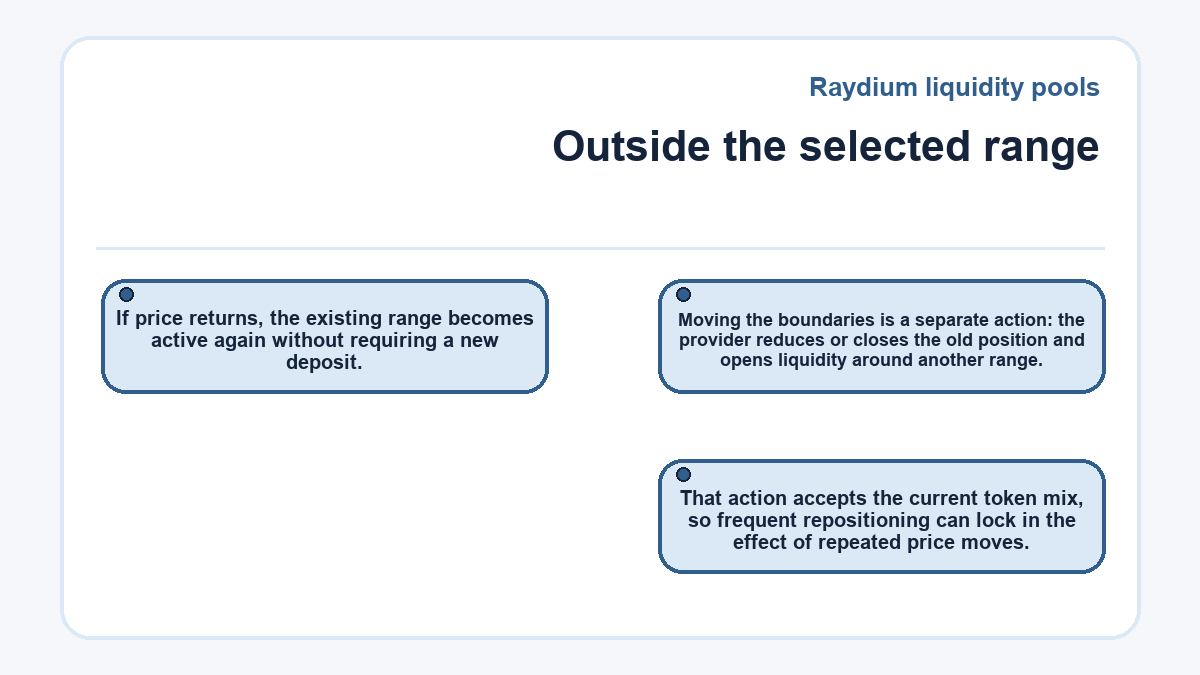
If price returns, the existing range becomes active again without requiring a new deposit. Moving the boundaries is a separate action: the provider reduces or closes the old position and opens liquidity around another range. That action accepts the current token mix, so frequent repositioning can lock in the effect of repeated price moves.
Fee tiers influence revenue and order flow together
Each CPMM or CLMM pool is bound to a fee configuration that determines its trade fee and the share allocated to liquidity providers. In CLMM, the configuration also determines tick spacing, which constrains the price boundaries available to a position. Read the live fee settings for the particular pool rather than assuming that a published tier still applies. A CLMM pool's tick spacing is fixed at initialization.
A higher rate collects more from each qualifying swap, yet it can make the pool less competitive for routing. A lower rate may attract more volume while paying less per trade. Some CPMM pools can add a separately configured creator fee, while some CLMM pools can apply a dynamic fee component. Compare the live base fee, LP allocation and any additional fee behavior before estimating revenue.
Range width determines the CLMM management burden
Two nearby boundaries concentrate capital tightly and can produce a large share of fees while price remains between them. The same position reaches an edge sooner when the market moves. Wider boundaries keep liquidity active across a larger price interval, although each unit of capital has less density around the current price.
Expected price behavior matters here. Assets that usually move together may support a narrower range, but correlation can weaken and a peg can break. Weakly related or volatile tokens need more room if the position is meant to stay active. Historical movement can inform that choice, but it can't set a boundary that remains suitable indefinitely.
Your available monitoring time matters too. A range that needs attention every time price approaches an edge conflicts with a low-maintenance plan. Widening it reduces that pressure; choosing CPMM removes the boundary altogether. Neither action removes the change in token composition caused by pool trading.
Price divergence can create loss relative to holding
Impermanent loss is the gap between the value of an LP position and the value of simply holding its deposited tokens through the same price movement. Constant-product trading sells some of the token that rises and accumulates the token that falls as arbitrage restores the pool price. Fees can offset part or all of that gap, but they don't prevent it.
Concentrated liquidity adds another layer. A narrow in-range position has greater exposure to inventory conversion than full-range liquidity, and an out-of-range position ends up on one side. Withdrawing at that point fixes the current token mix. Returning to the original price later doesn't undo a withdrawal that has already converted the position into wallet balances.
Fee estimates should therefore sit beside the holding comparison. To evaluate the outcome, combine the position's current two-token value with collected and unclaimed fees and any incentive rewards, then compare that total with holding. Looking at only one side can make an active but losing position appear profitable.
Position records change how providers collect fees
CPMM ownership through LP tokens
CPMM issues fungible LP tokens representing a pro rata share of the reserves. The LP portion of trading fees remains in those reserves and increases the value represented by the tokens. There is no separate LP fee balance to compound manually. Redeeming LP tokens returns the corresponding share of both current reserves.
CLMM ownership through a range position
A CLMM position record identifies its lower tick, upper tick and amount of liquidity. Its position NFT isn't interchangeable with another range merely because both use the same token pair. Fees accrue to that specific position and don't automatically become additional liquidity. Compounding requires collecting the fees and adding them back through another liquidity action.
Range status, current token amounts and unclaimed fees answer different questions. The range shows whether new fees can accrue. Token amounts show the inventory created by price movement, while fee balances show what prior in-range trading produced. All three are needed to evaluate the position.
Token compatibility comes first in the deposit checklist
Start with the exact mint addresses and token programs. If either mint can't use the selected pool program, stop and choose a compatible type before comparing yields or setting a range.
- Match both mint addresses to the intended pair rather than relying on symbols alone.
- Read the pool program, active status and live fee configuration from the selected pool.
- For CPMM, confirm that the proposed deposit uses the reserve ratio shown for that pool.
- For CLMM, confirm that the current price, chosen boundaries and available token amounts produce the intended position.
- After signing, verify the resulting LP-token balance or CLMM position record and its deposited amounts.
An absent position record or unchanged balances don't prove that a deposit succeeded. Check the transaction result before signing another attempt. Once the ownership record appears, compare its pool identifier and token mints with the selection made before signing. That independent check distinguishes a completed deposit from a wallet display delay or a failed transaction.
Incentives and legacy pools remain separate decisions
Incentive rewards, where configured, follow their own availability, duration and eligibility instead of changing the underlying swap curve. They may end while the pool continues trading. Legacy AMM v4 pools can still matter where existing liquidity is deep, but they don't support Token-2022 and aren't the default for new pools. CPMM fits liquidity intended to remain active without range resets. CLMM fits capital that can be monitored and repositioned when price leaves its boundaries.
Still wondering about Raydium liquidity pools?
Can I add liquidity with only one token?
A one-token deposit is possible for some CLMM positions. Raydium CLMM can open a position with one token when the current price is at or outside the corresponding range boundary. CPMM deposits generally require both assets in the pool's current ratio. A single-sided CLMM entry still carries price-range and token-conversion risk.
Can Token-2022 assets use every Raydium pool type?
No, Token-2022 compatibility varies by pool program and mint extension. CPMM and CLMM support Token-2022 mints subject to extension constraints. AMM v4 doesn't support Token-2022. Transfer-fee mints can also reduce amounts received during deposits, swaps, withdrawals or reward collection.
What happens to the token amounts when liquidity is withdrawn?
Withdrawal returns the position's current token composition, not the quantities originally deposited. CPMM returns a proportional share of its current reserves. CLMM returns the range-dependent token amounts plus separately accrued fees under its collection mechanics. Price movement can therefore leave the provider with more of one token and less of the other.
Last updated ·